

Beyond the Six String Nation #64: Bracketed by the Beatles
(When) I'm 64

Today is my birthday.
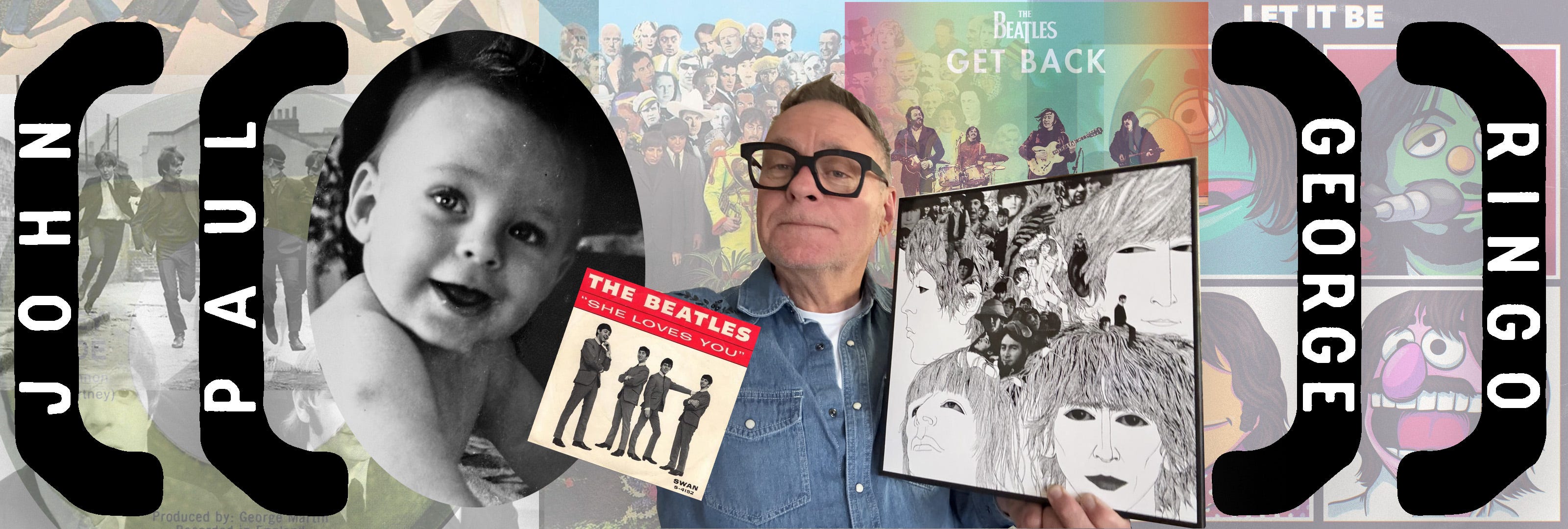
I was born in Kampala in 1962, a few months before the Beatles had their first hit, Love Me Do. Family lore is that I used to wave my arms, bob around and scream along with She Loves You (Yeah Yeah Yeah) when it would have come on the radio ubiquitously in August of 1963. Dad brought us all back to Canada in 1964, soon after the Beatles history-making appearance on the Ed Sullivan Show and my sister was born at the end of that year.
In 1967, my aunt Pam in London mailed us a copy of the Sgt. Pepper’s Lonely Hearts Club Band album - the UK version on the Parlophone label with the glossy album cover material. It was in constant rotation on the Clairtone and we learned it by heart as a family. The first new album I ever bought with my own money was Let It Be, purchased at Sam the Record Man on Yonge when I was 8 with my family waiting outside in the car on Gould St.
Like so many of my generation, the Beatles were a looming presence in popular culture that extended beyond normal fandom. They were a cultural yardstick through multiple movements and moments. They were the band to whom everyone was compared and declaring oneself to be either a Beatles person or a Rolling Stones person was a fundamental tribal affiliation that was a fork in the road for which branch of pop music you were destined to travel. All of that was nonsense of course but it felt pretty real at the time.
When I was at Milneford Junior High School in 1976, the album 3:47 EST by Klaatu came out and – spurred by a rumour in the Providence Journal proposed by Steve Smith – it seemed the world believed it must have been a secret reforming of the Beatles. As Torontonians, we knew that they were a local band. In fact, the producer of that album, Terry Brown, lived in our neighbourhood and I interviewed him for the school paper. But it showed how thoroughly something as seemingly ephemeral as record production had been absorbed in the public awareness as being “Beatles-esque” to the point where it created a phenomenon. So many records since then have been measured in terms of how much they sound like this or that Beatles album.
I grew up being told that the point of “pop culture” was that it was temporary, fleeting even. It was always a surprise that something lasted longer than 10 years. The Beatles themselves only lasted as a group for 10 years. And the opening line on Sgt. Pepper - “It was 20 years ago today, Sgt. Pepper taught a band to play…” seemed to be from some impossible future time. Just as the song When I’m Sixty-Four, seemed to have Paul McCartney imagining an impossibly distant and dottering future. And here I am today - living that future without dottering (I sincerely hope!)
When we went to see Ryan Gosling’s latest, The Hail Mary Project, I was struck by the use of the Beatles’ Two of Us in one poignant sequence. Here’s a contemporary filmmaker making a blockbuster for a contemporary audience and using a Beatles song in a key moment- though, of course, Beatles songs have been used in a ton of movies over decades and entire films have been built around their music. We watched all of Peter Jackson’s fine-tooth combing of the Let It Be album in his remarkable and riveting documentary Get Back. We devoured all the episodes of the less remarkable but equally interesting Anthology series. No doubt we will watch the four separate biopics covering each of John, Paul, George and Ringo when they start coming out later this year. Apparently, the machine that Paul McCartney and Yoko Ono have built to keep the Beatles at top of mind is working as expected. But when they go (Paul is 83, Yoko is 93), will the machine keep churning?
When Stephen Colbert’s The Late Show on CBS came to an end in the Ed Sullivan Theatre last month, Paul McCartney helped close the show as a bracket to his own career - throwing the switch to dark as the audience sang along to the Beatles Hello Goodbye. It truly felt like the end of multiple eras at once.
When McCartney wrote When I’m Sixty Four, he had an elder version of himself in mind and planted that picture in the minds of everyone who heard it. He probably didn’t dare imagine himself as 84 back then. Now that I’m 64, I’m going to have to imagine that milestone for myself without a musical cue.
Incidentally, the place of “She Loves You” on Rolling Stone’s 500 Greatest Songs of All Time list? 64.
Happy Birthday, Jowi! Great piece.