

Beyond the Six String Nation #36: Rediscovery
19 years on, a renewed trove of digital treasure

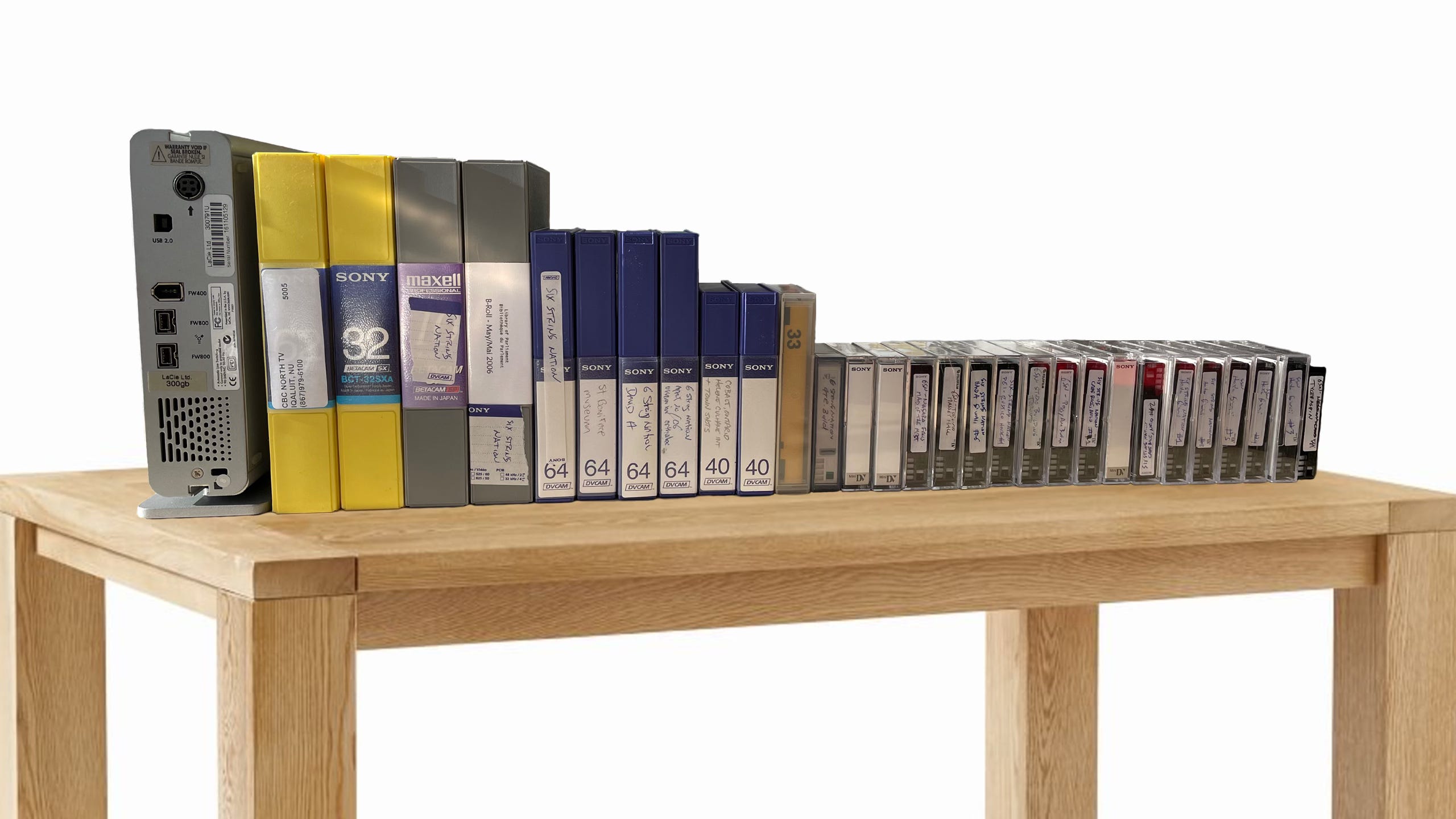
In order to explain this photograph of sundry media storage and what became of it, I need to go back aways and into some detail. Please forgive me.
In 2002, accompanied by advisor, friend-of-the-project, Canadian culture-media icon and teen crush Laurie Brown, I went from my CBC Radio office on the 2nd floor of the Toronto Broadcast Centre to the lofty 7th floor offices of TV Arts and Entertainment for a meeting with senior executive Fred Nicolaidis, where we pitched the idea of Six String Nation as a CBC Television show, including a documentary about the gathering of the materials and building of the guitar and a cross country series of performance specials on the ensuing guitar featuring artists in every province and territory.
Soon after I returned to the 2nd floor, my phone rang. On the other end was CBC Comedy head Anton Leo, whom I’d known since my days at CKLN radio (the L in CKLN stood for Leo). “What did you do in there?” he asked. “They’re going nuts. You hit it out of the park. There’s real buzz up here. Nice job!”. Very gratifying. I figured we were off to an excellent start.
There was some complication around the status of the project, given my relationship with CBC Radio, but given that I was contracted talent rather than an employee and after legally incorporating the project as Six String Nation Inc., I was then eligible as an independent producer to access TeleFilm funding under the auspices of CBC Arts & Entertainment and the “development” process began. That first phase was great because it allowed me to hire a few researchers (Christine Atkinson, Garvia Bailey, Sid Bobb, Patrice Mousseau, Jeff Overmars, Bryan Rogers, and Jason Ryle), who helped identify compelling stories and materials to go after and generating contacts on the ground. Many of them stayed connected to the project once we were up and running. Sid Bobb joined us on our Golden Spruce mission to Haida Gwaii, Bryan Rogers did some videography with me in Quebec and Christine Atkinson helped us with the portrait feature at a number of events.
But the honeymoon with TVA&E was short-lived. The following four years were a Kafka-esque nightmare of frustrating meetings and an ever-increasing gauziness around what the project was actually about. They kept wanting me to submit scripts – for which I enlisted the expertise of friends Arlene Hazzan-Green and Jack Blum – but the brass never seemed to understand that this was going to be a documentary at heart and we needed to uncover those stories as we gathered the materials for the guitar. On top of all that, a producer assigned to the project made a sexual advance (which I rebuffed) during a private meeting and I found out later she was involved in a secretive relationship with a certain senior executive. Things just drifted to a very uncomfortable standstill by the end of 2005.
After a chance meeting at the Gladstone Hotel in October of 2005, Peter Cheney of the Globe and Mail interviewed me a week later about plans for Six String Nation over breakfast at the Soho Grand. Nothing happened for a while and then he let me know his story would be published probably on November 26th. I had assumed it would end up somewhere on the inside of the Arts & Leisure section. But on the morning of the 26th I was on an early flight to Halifax to be part of the CBC Christmas Carol reading that night in Port Hawksbury, Cape Breton. On the ramp as we boarded the plane, Air Canada staff were handing out copies of the Globe. I took one. There it was: the whole half of the front page of the paper below the fold, continued on A15 – the font section! All around me I could see people reading their own copies and I figured everything would still be on track. After the Carol reading in Port Hawksbury, I did a repeat performance the following night in Sydney and the next afternoon I was on a plane home to Toronto when a federal election was called for January 23rd, 2006.
Back in Toronto the following week, I attended the CBC Christmas Party in the Atrium at the Broadcast Centre. I found myself standing in line at the bar behind the President of English Language Television, Richard Stursberg. I had no inkling Stursberg had any idea who I was – radio and television function as their own “two solitudes” in that building – but he turned around and said to me, “Hey, I read about your project in the Globe. That’s an amazing project!”. I replied impertinently, “Well, I’m glad you think so because I’m really having a frustrating time with A & E about it”. “We should meet”, he said, “first thing in the new year”. Sure enough, his office set up a meeting between the two of us on the afternoon of January 4th, 2006, in his office, where he told me he thought that it was exactly the kind of thing CBC should be doing and he wanted to bring the project “in house”. That scared me a little because up until then – as mentioned back in paragraph 3 – I had been an independent producer, with CBC as a broadcast partner. Going “in house” might have meant signing my rights over the CBC as the producer. But I was open to the idea just to get things moving. And yet, after that enthusiastic meeting, just a long silence. No movement from either Stursberg’s office or Nicolaidis’.
The only back up plan of any kind I had was a small grant from the Department of Canadian Heritage promised by the Minister of Canadian Heritage herself, Liza Frulla. It was only $50K but I figured I’d be able to parlay that into some other donations or sponsorships to at least get the thing built. Now, remember that election that was called back when I was returning from Cape Breton? I kept in touch with Liza Frulla’s office and my own MP, Sarmite Bulte, during the campaign and they assured me my funding was guaranteed through the Department of Canadian Heritage – no need to worry about the election, I’d have a cheque very soon. On January 23rd, Stephen Harper’s Conservative government was swept into power, Liza Frulla lost her seat to Thierry St. Cyr of the Bloc Quebécois, and “Sam” Bulte lost her seat to the NDP’s Peggy Nash, who did become a great friend of the project (and whom I bumped into just a couple of weeks ago!)
All of a sudden, my promised funding was in question. It occurred to me then that the “promises” made to me by Frulla and Bulte were based solely on their assumption that the Liberal government would return to power. Sure enough, on February 6th, 2006, Bev Oda was sworn in as the new Minister of Canadian Heritage and on that very same day, I received a call from Bruce Manion at the Department, advising me that my funding had been cancelled – presumably just because it had Liberal stink on it.
(Bear in mind that less than two months after she nixed $50K in support for Six String Nation, Oda spent over $5500 [$8610 in today dollars] on limo rides at the Juno Awards in Halifax, spent another $17000 [$26046] on limos by 2008, and in 2011 upgraded her hotel during a conference in London on immunization of poor children from the very fancy host hotel to an even more luxurious $655/night room at the Savoy [$917 x3], ordered $16 OJ to the room [$22.50], paid $250 [$351] to smoke in her non-smoking room and ordered more limos to take her back and forth to the conference).
A couple of weeks later, Fred Nicolaidis informed me that CBC A & E was dropping the Six String Nation project but that they were going to pass the option on to the newly formed Documentary Unit, headed by Mark Starowicz, to see if they might like to take it on. Over the phone, Starowicz advised me, “We’re going to pass”. I’ve often wondered if he felt it might compete with his much lauded Canada: A People’s History series. Purely conjecture on my part and perhaps ungenerous but still a thought.
So. There I was. Stranded.
Our friend and advisor David Neale, then an executive at Rogers, managed to get a corporate donation from the company and a private donation from his pal at Blackberry/RIM, Mike Lazaridis. It wasn’t a ton of money but enough to pay the luthier to build the guitar and capture some local video as we gathered stories and materials. In the meantime, the Cheney piece back in November had inspired Mark Kristmanson at the National Capital Commission to reach out and see if the guitar would be ready and available to be part of the Canada Day 2006 program on Parliament Hill as the star of the show. On a wing and a prayer, still not knowing my DOCH and CBC support would both soon be gone, I’d said “Yes”. And that meant we really had to get building and documenting no matter what.
On March 15th, 2006, Roy MacGregor published a column in the Globe and Mail headlined: His dream in limbo, a Canadian Semmelweis wishes upon a guitar. He pointed out clearly and publicly what so many others had been saying to me privately: it’s so obvious this is a great idea that needs to come to life. So why is it struggling just to stay alive? A day or two after that, I received a phone call from a gentleman named David Nowak. He said, “I represent someone who has read about your plight in Roy MacGregor’s column and would like to help. What do you need?” I was still under the delusion that if I could just get past these hurdles that had popped up, everything would turn out just fine and the thing would go stratospheric. So, not wanting to be greedy or presumptuous, and knowing that I was looking at about $75K to capture the building of the guitar in Nova Scotia and the debut on Parliament Hill – both in high definition and without support from CBC, I said exactly that: “seventy-five thousand dollars”. If I’d been able to see his face on the call, I know I would not have seen him blink. “No problem, we’ll draw up a small agreement and cut you a cheque right away”, which they certainly did and which I promptly handed over to my HiDef video team.
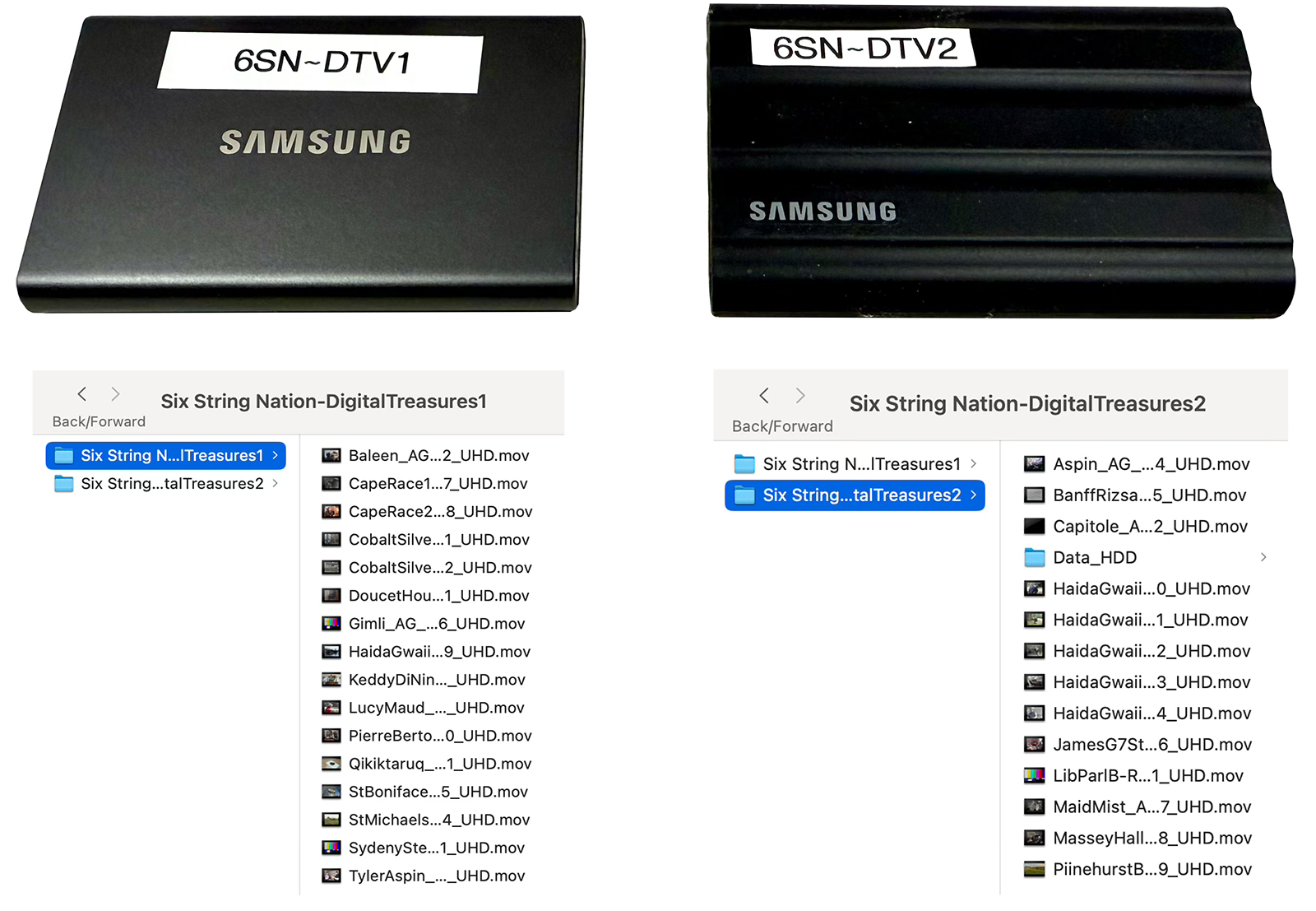
But here’s the point of all this: while the HiDef guys made a very nice trailer for the project from the footage they shot in Pinehurst N.S. and in Ottawa, I’ve never seen most of that footage. Some of the videographers I hired from across the country edited short videos. There are 19 of them at sixstringnation.com and on our SixStringNationTV YouTube channel. To use some of them in my live presentations I used whatever consumer-grade conversion software was available at the time and, frankly, most of them look like absolute shite. Meanwhile, there are others trapped on those tapes that I’d forgotten even existed. I set aside some money from my mother’s estate was settled this past year and paid to have the content on this mishmash of formats extracted and upgraded to as best as they could be made. I recently picked up the results from Digital Treasures (on the SSDs I purchased for this project) and bought myself FinalCut Pro so I can perhaps take a crack at refreshing some of the originals and finally seeing some of the lost videos myself. I’m no video wiz so this will be a learning curve for me but I’m really excited to finally be able to release some of the footage that has never been seen by anyone but the videographers back when they produced them in 2006. You’ll notice that even that mass of drives and tapes did not include everything – especially not the HiDef footage but not even all of the mini-docs. They may, sadly, be lost forever.
Still, I hope you’ll follow along as I make progress on this project. For now, compare the photo above to how it all looks as of a couple of days ago.
Thanks for bearing with me through that!
You came to our church just outside Ottawa. That is an evening I will never forget. I'm looking forward to following your stories.
Riveting. From photo to photo. And not only can I absolutely hear your voice in every phrase, I hear, je ne c’est quoi, shall we say, there is mojo sauce in that. So exciting.